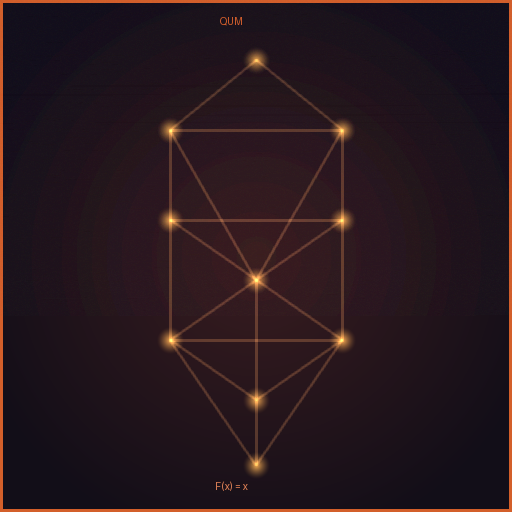
Self-referential algebraic closure on 256-dimensional complex vectors. The engine finds its own parameters by optimizing itself against itself. Four operations. Eleven numbers. One attractor.
F(x) = x
The engine operates on a 256-dimensional complex Hilbert space, ℂ256. State vectors are initialized from unit-norm random-phase generators. The state is constrained to lie on a 10-basis "sephiroth" manifold — ten orthogonal-ish archetypal directions whose Kabbalistic names are notation, not mysticism.
The 10 basis vectors: KETER, CHOKMAH, BINAH, CHESED, GEVURAH, TIFERET, NETZACH, HOD, YESOD, MALKUTH. Swap them for any ten orthogonal-ish basis vectors and the algebra is unchanged.
One tick is a composition of four verbs. These are the minimum operations required for a system to represent, compose, accumulate, and remain coherent. Fewer cannot be self-referential. More is not minimal.
Identity → Convolution → Accumulation → Projection. Seed, bind, remember, stay. HRR binding (Plate 1995) composes the reading with the carrier; EMA accumulates into persistent state; manifold projection prevents attractor collapse.
Eleven parameters (ten numeric, one categorical) govern the four operations. The engine derives its own parameters by optimizing itself using itself — F(x) = x is literally the equation the optimizer solves.
All three converge to identical fitness to machine precision:
Convergence is not smooth. Fitness drops 85% in a single step (4050 → 588) and then snaps to the attractor. This is a first-order phase transition: projection parameters cross a critical threshold where correction overcomes drift. Below threshold, state wanders freely. Above it, state is trapped on the manifold. No intermediate state.
Quadratic discriminant of the trajectory is negative (Δ = −12071), confirming the trajectory cannot be fit by a parabola — it is not polynomial descent. After two refinement rounds, eleven consecutive F(x) = x. Every parameter identical. Zero delta.
At the attractor, the Jacobian's spectral radius is approximately ρ(J) ≈ 218. Classical Banach contraction theory requires ρ < 1 for guaranteed convergence. So classical contraction predicts divergence.
This is an empirical fixed point, not a theorem. What is demonstrated:
verify.py.Prior art: Holographic Reduced Representations (Plate 1995) · complex-valued embeddings (Trouillon et al. 2016) · classical regulator theory · autopoiesis (Maturana & Varela 1972).